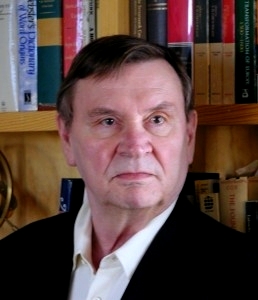
MR. MORGAN: You are Dr. Stark, is that right?
DR. STARK: Yes.
MR. MORGAN: What is your occupation or calling?
DR. STARK: I am Professor of Sociology and Comparative Religion at the University of Washington.
(Curriculum vitae dated August 1983 of Rodney Stark marked for identification as plaintiff Exhibit 22.)
MR. MORGAN: Let me show you what’s been marked as Exhibit 22, and I will ask you to identify that document.
DR. STARK: Yes, it is my vitae.
MR. MORGAN: How current is your vitae?
DR. STARK: Well, this is 1983. I guess there’s been another book, and I suppose far too many articles.
MR. MORGAN: I will offer that into evidence at this time, Your Honor.
JUDGE SEYRANIAN: Be accepted.
MR. MORGAN: Do you want to tell us something about your education, where you went to college and what degrees you received?
DR. STARK: I got a degree in journalism from the University of Denver, and I have an M.A. and a Ph.D. from the University of California at Berkeley.
MR. MORGAN: And the Ph.D.?
DR. STARK: Sociology.
MR. MORGAN: Did you also have some experience in journalism?
DR. STARK: Yes, I was a reporter for the Oakland Tribune and the Denver Post.
MR. MORGAN: Can you tell us what years you did that?
DR. STARK: The Denver Post in the middle fifties, and then I was in the army, and then I was at the Oakland Tribune in ’59 and ’60, and I think a little bit of ’61. That was a very long time ago.
MR. MORGAN: Then did you go to Berkeley?
DR. STARK: Yes. Well, I started at the Tribune, and then after a year of that I started at Berkeley, and then I did both for awhile.
MR. MORGAN: Do you have some particular specialty at the present time?
DR. STARK: Yes, I would have to say that my specialty all along has pretty much been the sociology of religion with particular emphasis, say, in the last period in religious movements.
MR. MORGAN: Can you tell the court generally what is the field of sociology of religion?
DR. STARK: It is anything anybody wants to call it, but as opposed to historians, we are not so interested in a specific group over a long period of time as opposed to psychologists or anthropologists.
There are many things. What is the effect of religion on crime rates, for example, would be a perfectly appropriate set of topics. What is the nature of religious movements, how do they recruit, how do they form, how do they grow, what separates the winners from the losers. That would also be the sociology of religion. What is the implication of Protestantism on the rise of industrialization in western Europe is another classic area, so it goes all over the map.
MR. MORGAN: You have indicated that you were in 1982 and 1983 the president for the Association for the Sociology of Religion. Can you tell the court something about that organization, what it is?
DR. STARK: Well, it is an international scholarly society made up of people who are sociologists in religion.
MR. MORGAN: As president, is that an elective office?
DR. STARK: That is an elective office, and it is largely ceremonial and honorific.
MR. MORGAN: Then you have listed a number of pages of books and articles. I won’t go into those, but I gather that you have written constantly, is that correct?
DR. STARK: It is my disease.
MR. MORGAN: Were you requested to make an evaluation for me of the “Local Church,” its people, and the publications by SCP and Mr. Duddy?
DR. STARK: Yes, I was.
MR. MORGAN: Can you tell the court what you did in that regard? Were you also asked to do something else? Were you asked to review something in the book regarding the use of your name?
DR. STARK: Yes, I was asked to read some pages, which didn’t take very long, that purported to explicate something that I have gotten some, I guess, notoriety or whatever for. It is a theory of conversion that’s been around for twenty years, and I was asked to see if Duddy had reported it correctly and applied it appropriately.
MR. MORGAN: We will get to it again later, but what was your conclusion?
DR. STARK: If a student had ever given me that, a freshman, I’d have flunked him.
MR. MORGAN: Tell the court what you did by way of study of the “Local Church” and review of the publications.
DR. STARK: Well, to a much less extent than some of the earlier witnesses, I have gone out and met members. I have attended some services. I have been in the Freeman home. I have seen the headquarters in Seattle. I have looked at a lot of TV tape. I have read or read parts of a substantial number of publications by Witness Lee.
MR. MORGAN: Let me go now to the publication. Does The God-Men purport to be a sociological study of the “Local Church”?
DR. STARK: Yes, it does. It says specifically in the very beginning of the book that it has two basic strands that it is going to evaluate: on religious grounds and on sociological grounds.
MR. MORGAN: Can you comment for the court your opinion as to the merit of the sociological study?
DR. STARK: It has none.
MR. MORGAN: Can you tell us why it has none?
DR. STARK: Well, first of all, there is not the slightest effort to have given it any. As was said earlier today, there is no methodology; there is no social science here. No one collected any data. No one tried to formulate any testable hypotheses and see if they were confirmed vis-.-vis what goes on in the “Local Church.” There isn’t a shred of sociology to it. There is the invoking of some sociological trappings.
MR. MORGAN: Are there some accepted methods of sociological study of religious movements?
DR. STARK: There are a varied number of them, I suppose. One could, for example, go out and do some observation. One could go out and hang around a group, be with a group, watch them.
So when John Lofland and I did research, for example, on the basis of the conversion theory, we went out and found a group in San Francisco, and we spent a couple of years, Lofland more than I. We spent a large amount of our time with those people, watching people actually join religious movements.
It is all well and good to sit in a library and speculate about who might have been attracted, but the only way you can find out who would be attracted is to go and see who is attracted and who comes in and fools around and nibbles a little bit and says no and goes away. That is the only way it can be done.
One could, of course, having some reasonably well-fashioned notions, give people questionnaires. This could be done very usefully.
For example, Eileen Barker at the London School of Economics has for many years now been giving questionnaires to all people who show up in London at the first workshop, say, of a Unification Church, the Moonies. They let her do it. The people fill them out. She’s now got data going ten, twelve years. In the long run she knows who actually joins the church, who stayed, and when they quit. That is science. That is social science. There is none of that here.
MR. MORGAN: Let me ask you, would it be social science to talk to three, four, five ex-members and then use that as your basis?
DR. STARK: Well, we don’t have to talk social science, that wouldn’t be journalism.
MR. MORGAN: Why not?
DR. STARK: My city editor at the Oakland Tribune would have canned me for something like that. Let’s get religion out of here.
Let’s say he says, “Why don’t you go out to Cal, and see how the Sigma Chi are doing.” I go out to Cal, but I can’t find any, but I can find three guys that de-pledged for whatever reason. Maybe they were cuckoo. I go interview these guys about Sigma Chi at Cal, and they tell me they are a bunch of bums and this, that, and the other thing.
What do I know? I don’t know anything that I can trust. The best way, I suppose, would be to walk in the Sig house, give them the secret handshake, and hang around for a few months or whatever.
I took this out of religious context intentionally because what would you say about interviewing five guys who had gotten disbarred in Alameda County about the Alameda County Bar Association. Or say they hadn’t gotten disbarred; let’s say they had gotten disgruntled and had gone to be chiropractors. That is not the way you go about these things.
MR. MORGAN: Let me ask you to refer to The God-Men‘s use of the phrase, “The Seduction Syndrome.” Is that a sociological term?
DR. STARK: I had never seen it before, until I was given a copy of The God-Men to look at.
MR. MORGAN: First it mentions Dr. Anthony Campolo. Who is he?
DR. STARK: I have no idea.
MR. MORGAN: Then Duddy goes on; he says:
Dr. Anthony Campolo, an evangelical Christian sociologist who teaches at the University of Pennsylvania, has done exceptional research on the topic of cultic religious conversions. He endorses the Lofland-Stark model of conversion as a useful basis for understanding conversion from natal beliefs to a deviant religion.
Lofland-Stark, does that ring a bell?
DR. STARK: Yes, that is John Lofland and Rodney Stark, “Becoming a World-Saver: A Theory of Conversion to a Deviant Perspective,” American Sociological Review of 1965. We were young; we had much to learn, but we broke new ground then. So everything kind of seems to go back to this stuff, although I must say there are 1980 versions of this thing that are a whole lot less antique but, yes, I do recognize this.
MR. MORGAN: For the benefit of some of us, what is a model? What are we talking about?
DR. STARK: A theory in which we lay out some variables or some steps or some conditions or set of propositions trying to explain how it is that people go from A to B.
In this case we are talking about how is it that people ever decided to take up a new religious belief system which is quite different, say, than why a person in a Christian tradition, raised as a Christian, suddenly gets much more committed to his Christianity and talks about having a conversion.
I am talking about what happened to Paul. He was a Jew one minute, and he was a Christian the next minute. We are talking about a shift in perspective. What we attempted to do was to explain how this occurred.
MR. MORGAN: Also Mr. Duddy writes:
Other prominent sociologists in accord with Campolo include William Bainbridge of the University of Washington.
Do you know William Bainbridge?
DR. STARK: I have published about twenty-five papers with him and I guess the third book is on the way, so, yes, I have written with the man quite a lot.
MR. MORGAN: In your opinion, would Mr. Bainbridge approve of Mr. Duddy’s utilization of the Lofland-Stark Model here?
DR. STARK: He would throw up.
MR. MORGAN: Mr. Duddy goes on, then, to in effect restate your model. Does he accurately restate it?
DR. STARK: No. He does not. He misses the entire point.
MR. MORGAN: Maybe I could ask you first to tell the court in substance what Mr. Duddy says is your model.
DR. STARK: The model basically has two sets of elements. We could call them background elements and process elements.
The background elements are characteristics of individuals that they develop over time or they were born with. These are the characteristics people bring with them to the situation in which they encounter either family and friends who have suddenly taken up a new religious outlook or they run into people who are out there with a new religious outlook, new in terms of their background.
These people could be Baptists or they could be Moonies, but different from your previous background. All right. So there are those aspects. Those are the aspects the social science had always concentrated on.
Well, these people must be feeling a little antsy, to the extent that they aren’t perfectly satisfied with their religion. They must probably not be complete atheists if you are going to try and convert them to religion. If they absolutely cannot accept the conceivable, that there is a spiritual world, presumably there are some background beliefs that lock people off from the possibility of changing. Somebody who is a very satisfied Catholic doesn’t become something different.
So we isolated some of these conditions, and we get to a point where we are talking about a turning point in people’s lives. I hate the language now. But what it really meant, and we spelled it out, is that people are structurally more or less available during the course of their lives.
When you are married and have a job and five kids, you have less freedom to conceive of a new kind of life. When you are nineteen years old and just came to San Francisco from Biloxi, Mississippi, and you are looking for a job, you have got a lot of options open. You still don’t know what you are going to be when you grow up, and you haven’t got a wife and kids. People who are in that condition of freedom often find it much easier to shift who they are and what they are going to be when they grow up.
But up to this point we are talking pretty conventional social science, and we are kind of saying it is not important because there are millions and millions of people out there who meet all of these conditions and yet very few of them ended up joining the particular group we were looking at.
And so at this point we introduced what we thought was the guts of the model, which is a process of interaction between the potential convert, if you will, and the group to be converted to. It is at this point that the door comes down, Duddy stops reporting the model, and in other words, he skips everything important in the model and comes with some flat assertions that are completely, almost diabolically, the reverse of what the model says.
MR. MORGAN: In your opinion, could Mr. Duddy just have misunderstood your model?
DR. STARK: Well, it’s possible he never read it. No, it is entirely possible that he got a third- or fourth-hand re-chew of the thing that other people have been grinding up and passing around. It becomes almost an oral tradition out there. I can’t be in Mr. Duddy’s mind, and Mr. Duddy has told me nothing. I don’t know whether he actually went and consulted the paper or not.
MR. MORGAN: But if he read it?
DR. STARK: If he did, then one doesn’t want to underestimate the capacity of idiocy. I am forced to conclude that if he did read the paper, this was malicious.
MR. MORGAN: And how did he alter the model?
DR. STARK: What Lofland and I say is, hey, the world has millions of people out here qualified to change religions, and they definitely do not do that because certain social processes and conditions are required for conversion to occur. To sum it up, you end up accepting the religious views of your closest associates, whether these are new associates or old associates.
Very frequently people join a new religion because their friends and relatives join it before them, and this spreads through pre-existing friendship nets and bonds, which is the way the real world works; we influence one another.
The reason most of us don’t steal is because we influence one another. We kind of keep each other straight, and what we discovered watching conversion is that if people had more and closer ties to the group than they had ties to people outside the group trying to pull them back, they joined, but if the equation worked out the other way, they didn’t join. The marvelous thing is how unimportant frequently religion was in this whole process.
That people could, in fact, hang around a group, like them, maybe be relatives of them, friends with them, whatever, but be there in a long period of close association expressing little or no interest in the religion and no belief in it, and eventually having their interest kindled by the fact that their friends really did care and were committed, and finally building up to a point, saying, you know, it just came to me last night that I have been just kind of wasting my time and failing to see the truth, and suddenly comes the vision.
Then a lot of things can get recoded by these people saying, actually I was always interested in religion. In my observation, watching them, they typically weren’t.
MR. MORGAN: How did Duddy’s differ?
DR. STARK: What he says, first of all, is that it is like knocking passenger pigeons out of the trees at this point. He is talking at this point of how any experienced proselytizer can take these people right over:
The fourth, final stage in the seduction syndrome is the turning point-a moment of transition, migration or uncertainty such as a change and/or failure in career or school, divorce, etc., that renders the pre-convert rootless, thereby susceptible to messianic figures/groups. If, through peculiar happenstance, persons in the fourth state (the turning point) of the seduction syndrome-
MR. MORGAN: That is not your words, is it?
DR. STARK: No, there are no such words. I mean, it is a word but-
-meet a purveyor offering to solve their personal problems within the natal method of the pre-convert, a conversion inevitably results (barring a “fumble” by the group’s representative or leader). Conversion, say Lofland and Stark, can be readily achieved by skilled proselyters.
It is not so. If I said it, I was an idiot. I hope that I can do a better job pretending not to be.
MR. MORGAN: You’re saying, “It did not say that”?
DR. STARK: It did not say that. It said the reverse! Still, conversion is very rare of people who have fulfilled all these stages of the model, gotten to the turning point. What we were trying to stress was that the world is full of people. How many nineteen year olds are there? There are millions. There are all kinds of people who have just gotten divorced, just changed to a new town, just gotten out of school, just flunked out of school, or whatever.
There are lots of people who are loose and available and who might not think that their religion satisfied. There are millions of them, but they don’t join groups. In order to do this you have got to build bonds of friendship and trust and affection and concern and interest.
I will bet there’s never been anybody show up to the door of the “Local Church” saying, “Got your tract, here I am. I am ready to join.” I have never seen a conversion like that happen in my life.
MR. MORGAN: Have you also made studies on what happens after the conversion? How many stay?
DR. STARK: Well, I haven’t done a lot of that, but there certainly has been a great deal done on that. That will vary. Frankly, the people who join liberal Protestant congregations don’t stay because there is no cohesive group life to hold them there. The more affection that people give you, the more you feel good about being someplace and the more you want to stay there.
Now in terms of what you might call the really heavy- duty religious movement, that is asking tremendous commitment from you; I guess the heavier the request, the more frequently that there is turnover in membership.
Lots and lots of people go into these groups in which the turnover is very high. Eileen Barker, as I said, has been studying the Moonies for about twelve years in London. For every hundred people who actually show up at a workshop, so it means they have been preselected for having some interest, for being willing to come, for knowing Moonies.
They have been exposed to the mind benders. Out of every one hundred who comes, only about three ever join the church. Boy, is that a bad mind control. And of those, about half quit within the first eighteen months. So it must be relatively easy to do.
Of those who leave, it is hard pickings to find that many disgruntled people. People say, hey, that seemed like the thing to do, and boy, have I got a lot of good, warm friendships there, but now I think it is time to go do something else. That is kind of an interesting rhetoric compared to what we’re being quoted here. I have never met a skilled proselytizer. There might be some guy someplace who can just walk up and do that, but he is busy doing something else.
JUDGE SEYRANIAN: Do you believe that with some of these people that are converted, there is a need in the person that the people doing the conversion are able to satisfy a need? For instance, I remember reading in Helter Skelter that Manson says, “These were your children that you discarded or couldn’t relate to or couldn’t get along with. They were left sitting on the corner of the streets, and I came along, and they were in need of love and friendship, and I just provided it for them, and they came along.”
DR. STARK: Yes, I think he used a phrase like they were set out like the garbage.
JUDGE SEYRANIAN: He said, “I picked up your garbage.”
DR. STARK: There are people around desperately in need of a connection, and so sometimes conversion can happen pretty darn fast. I am more familiar with the Love Family in Seattle, which is now disbanded, than with Manson; this group doesn’t have nearly the ugly characteristics. They were a halfway house for all the sick and crazy and lost kids. You could crash with them. Some people found it real snug and real comfortable and real good, and so they stayed.
One of the interesting things is that now these people are approaching forty and have children; they’re feeling so good about themselves that they decided not to do it anymore.
MR. MORGAN: In the book Mr. Duddy is purporting to show that this was a sociological study, isn’t that right?
DR. STARK: Yes, of course he was. There was no reason to bring this in but to give it the trappings of science and say, “By the way, if the religion isn’t bad enough, and I have pointed out all these terrible, terrible, terrible things of being unbiblical, let me tell you these people have been identified as part of this ugly crowd by scientific sociologists. They come and prey upon you and upon your children. I guess they can pray-read too, but it is a sinister image. They are standing at the alley with the net.”
MR. MORGAN: Immediately following this statement about the skilled proselytizer there is a story about a young girl named Cia who gets ensnared in this; is that right?
DR. STARK: Yes, and as I recollect, the headline is that it is a case study. Well, a case study of what? I assumed that it was going to be some kind of effort to apply our model. It rambles away and doesn’t with any great clarity do that, but it is clearly there. My stuff is used as a front end, as frosting on the cake for a horror story that he is now going to tell, and I gather when all is said and done, it was all hearsay.
MR. MORGAN: And there is no support from your study for what he is saying, is there?
DR. STARK: No.
MR. MORGAN: Let me ask you this. You had a chance to study the “Local Church” people?
DR. STARK: Well—
MR. MORGAN: Not a sociological study.
DR. STARK: I didn’t sit on the couch with them or anything, but I saw and talked to them. Had very nice shortcake with them once. I needed it.
MR. MORGAN: Let me ask you, can you give us your opinion as to where they fit in the spectrum of Christianity?
DR. STARK: Well, being a sociologist of religion, I agree that Gordon Melton put them in the right volume of his book. They are without a doubt an evangelical Protestant denomination. Given the kind of moral tone of the group, one would call them a sect rather than a church, a church being a place where the minister says, “Well, a spot of Jack Daniels is okay and let’s go play golf,” a sect saying, “Well, we don’t need the golf course, and a 7-Up, please.” They fit right in the middle of evangelical Protestantism. We never thought to classify them as anything else nor would any sociologist of religion that I would know of.
MR. MORGAN: Are you saying they wouldn’t be classified as a cult in the pejorative term?
DR. STARK: Oh, pejorative or non-pejorative, I’m one of these idiots who clung to trying to use the word cult in a technical, sociological sense to mean a religious movement not in the main tradition of the society we are observing. So that Christianity is a cult movement in India; Hinduism is a cult movement in the United States.
I am now sorry I tried to fight this battle for twenty years because the newspapers have killed me. The newspapers are going to own that word, and it’s going to mean awful, awfulness. It is going to mean Jim Jones. It is going to mean bad things.
But, going back to the word cult as a technical, useful word; it is precisely what I have said: no, absolutely not! Because we are not talking here about structure. We are talking about doctrine. Are they still within the conventional tradition within American society, and the answer is so obviously yes.
MR. MORGAN: As a reporter you had a chance to review Duddy’s work by way of investigative reporting. In your opinion, would you describe for us the type of investigative reporting that you saw he did in this book?
DR. STARK: Well, I guess I have lost a lot of my faith in that old profession because the National Enquirer and lots of groups have come to the fore since then, but this isn’t journalism. First of all, it is clear the book was written backwards.
MR. MORGAN: What do you mean by that?
DR. STARK: The conclusion is where the book starts, that the Spiritual Counterfeits Project doesn’t go after people to go out and say, “Hey-it isn’t the Mobil four-star. We are going to give these people good ratings and these people bad ratings.” They only write attacks. The decision had been made. There had been earlier rumbles over here, after all, by the same group. Duddy was given an assignment, and he did it.
Unfortunately, he didn’t cover his tracks. He was extraordinarily careless, because as was clear in the depositions, he didn’t check anything. If all he was going to do was write a book being real nasty to Witness Lee’s theology, we wouldn’t be here today, because that is fair in American society. You can do that.
But the second you start naming names and events, discrediting events, sexual hanky-panky, financial hanky-panky, or indeed getting to a certain point of quoting a man’s theological statements diametrically opposed to what the man is saying, then I think we are not talking about religion; we are talking about truth; we are talking about libel; we are talking about fairness; we are talking about a whole constellation of things.
There is none of that here. This is the worst kind of rumormongering being passed off. But it is clear it was being done for a purpose, and it was systematic.
JUDGE SEYRANIAN: Being what?
DR. STARK: It was done for a purpose.
JUDGE SEYRANIAN: Do you know what that purpose was?
DR. STARK: Yes. For some reason, which I have no idea of, the “Local Church” was next on the hit list, and they got hit.
JUDGE SEYRANIAN: I have a question. Do you feel that when you write books of this type that people would be more likely to read something negative than positive?
DR. STARK: Sure. When I was at the Oakland Tribune, I can remember old Al Reck, rest his soul, sweet old city editor, jumping up and saying we have had a hell of a great air wreck.
JUDGE SEYRANIAN: Obviously the volume of these books that are sold is nothing compared to any kind of a hit list book, so you are not going to make money on the number of books you sell, but does anything in your studies show that publishing these books where people would read them with this kind of a story would create contributions that might assist whatever you are trying to do in your cause, in other words, the writers of this book would seek to get additional contributions because people read these things and say, “Hey, these guys are real crusaders out here.” Do you think that could occur in this kind of journalism?
DR. STARK: Well, I think the motive for this kind of journalism is to damage the group as much as possible.
JUDGE SEYRANIAN: Do you think people then contribute to these kind of things?
DR. STARK: Oh, absolutely. I think that the project has been sold to a lot of people in the evangelical world as a good work, as a terribly important thing to help us guard our children, and you said the book doesn’t have terrific circulation, but it can have very targeted circulation.
I met a young man. He had taken introductory sociology from me as a freshman. I didn’t know that because I had eight hundred kids in the room. I met him. He’s now become a member of the Local Church. When he was a student in my class and a freshman at the University of Washington, perhaps a sophomore, and had begun fellowshipping with the “Local Church” and was kind of checking it out, The God-Men was put on his bunk in his room in the dorm along with an anonymous note kind of suggesting that he ought to check out what he was playing around with because he was playing around with the devil, he was playing around with bad stuff. Here is a book published by what is thought to be a very legitimate—
MR. MORGAN: Inter-Varsity Press.
DR. STARK: Legitimate people. This is an evangelical kid, and so he is sensitive to the fact of anti-cult literature, if you will, and he didn’t know. As it turns out, some of the people in the book were people he had already gotten to know, and he realized that it didn’t wash.
But, sure, how many kids have been scared off? How many parents have been scared? The aim of this book is to keep the “Local Church” from converting the Christians to their particular denomination. That is the whole point. Spiritual Counterfeits is out there to warn. It is kind of a “consumer research” for the evangelical world as it is so conceived.
MR. MORGAN: His Honor asked you, do you have any opinion that by SCP achieving this so-called fame that they in turn get assistance and contribution from people throughout the country?
DR. STARK: I imagine that is a matter of public record since they are a nonprofit organization in bankruptcy.
JUDGE SEYRANIAN: What would your opinion be?
DR. STARK: Yes, of course. Let’s put it this way. I could peddle this. I could raise funds.
MR. MORGAN: Let me finish it now. What in your opinion has been the effect of this book, this manuscript on Witness Lee and the “Local Church”?
DR. STARK: Well, I think it’s been devastating, and I will give you as evidence an article in an extraordinarily influential publication a week or two ago called Christianity Today. It is the centerpiece of the evangelical world. They covered the fact that the trial didn’t take place when it was supposed to, and the fact of the bankruptcy, and whatnot.
It was exceedingly unsympathetic, skirting very close structurally to some of the issues here with us today, and I am sure that these are not bad people sitting out there in Illinois. I think they are very misinformed people who still think that (A) The God-Men was right, it was an accurate book, and (B) the terrible problem that the evangelical world is facing, we are about to lose our “Consumer Guide,” our consumer research agency, because these people are taking them to court and punishing them as an attempt to silence them.
That was the way this was reported, and I was prompted to write to the editor a long letter to try to clarify the moral issue of a day in court. But without the book, of course, there wouldn’t have been the story. But without the book, I don’t imagine that Christianity Today would be bothering much with the “Local Church” one way or the other. Gordon Melton is one of the few people on earth who had heard of them in my world until this book came out, and Gordon Melton has heard of everyone.
MR. MORGAN: Thank you. I have no further questions, Your Honor.
JUDGE SEYRANIAN: Thank you.
Copyright © 1995 Living Stream, Anaheim, CA, USA. All rights reserved. Reproduced by permission.