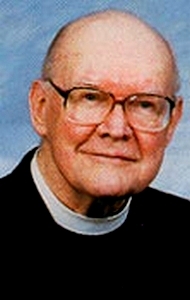
MR. MORGAN: What is your calling?
DR. GOETCHIUS: I am an Episcopal priest. I am Professor of Literature and
Interpretation of the New Testament and Professor of Biblical Languages at the
Episcopal Divinity School, and I also have a lectureship at Harvard University,
also in Interpretation of the New Testament.
MR. MORGAN: Is the Episcopal Divinity School affiliated with any university or
college?
DR. GOETCHIUS: Yes, sir, it is affiliated with Harvard and has been for many
years. It is affiliated with the Weston School of Theology, which is a Jesuit
Theologate. It is affiliated with the Boston Theological Institute, which is a
consortium of, I think, eleven various denominations including Greek Orthodox,
two or three Roman Catholic, one quite conservative Protestant, and that’s about
it, I guess.
(Curriculum Vitae of Eugene Van Ness Goetchius marked for identification as
Plaintiff’s Exhibit 21.)
MR. MORGAN: Let me show you what’s been marked as Exhibit 21, and I will
ask you if you can identify what that is.
DR. GOETCHIUS: That is my curriculum vitae.
MR. MORGAN: I will offer that into evidence, if I may.
JUDGE SEYRANIAN: It may be admitted.
MR. MORGAN: Just a few questions now about it. First, can you tell us
something about your educational background?
DR. GOETCHIUS: Well I never got out of it, I suppose, for one thing. I have
been in school all my life. I think I was probably afraid not to stay there.
But I went to the University of Virginia, as you see, for ten years where I received four degrees. What happened between 1941, when I got my B.A., and 1947, when I got my master of science, you may recall the unpleasantness of World War II, during which time I was teaching navigation in the Navy and meteorology to the Army Air Force, and so by doing that I got a degree in mathematics. So then I had to go back to Germany, and when I finished there, I felt called to the ministry. After finishing the Ph.D. in Germanic languages, I went to the seminary, and after having taught a couple of years in between, I went on to get another degree, another doctorate in New Testament interpretation.
MR. MORGAN: What do you teach now?
DR. GOETCHIUS: Well, I teach an introductory course in New Testament interpretation. I have been doing that since around 1963. I teach it in conjunction with a Jesuit professor and a Harvard professor who’s also sometimes a Jesuit. This sometimes makes my position very interesting, but the Anglican position has always been an interesting one, in between everybody else.
I also teach introductory Greek and secondary Greek at seminary and fourth-year Greek at Harvard, and I give a course on the Holy Spirit.
MR. MORGAN: You have listed all your articles that you have written in the Exhibit, is that correct?
DR. GOETCHIUS: I believe so. I am not very prolific, I am afraid, partly because of the field I am most interested in, which is grammar. I have written a Greek grammar, I am preparing to write a second-year grammar, and I have done work on a dictionary, which is still in alpha.
MR. MORGAN: Doctor, let me do this. Let me ask you now about when you first became aware of the “Local Church.”
DR. GOETCHIUS: Yes, it was through my teaching of Greek that this happened. One of the members of the church in Newton, Massachusetts telephoned me and said he would like to take Greek, and I assured him that he could register at the Episcopal Seminary. He said that would be inconvenient because I taught it at nine o’clock in the morning four days a week, and besides he had a number of friends who also wanted to do it. After some backing and filling I agreed to teach them on Friday evenings from 7:30 to 9:30.
MR. MORGAN: Can you give us an idea as to when that was?
DR. GOETCHIUS: That was in the fall of 1983.
MR. MORGAN: At that time had you had any awareness of either Witness Lee or the “Local Church”?
DR. GOETCHIUS: None.
MR. MORGAN: How long did this class last then?
DR. GOETCHIUS: Well, we finished the introductory grammar course in one semester, then we did reading in the New Testament for the following two semesters, and this is at the present the fourth semester. I am on sabbatical. They wanted to continue, but I was unable to do that.
MR. MORGAN: About how many from the “Local Church” attended this class?
DR. GOETCHIUS: We began with, I think, eighteen, and we ended with about a dozen.
MR. MORGAN: In addition to teaching them, did you have an occasion to be with them socially?
DR. GOETCHIUS: Yes. During the first semester they invited me, socially in the strict sense then, and during the first semester they invited me and my wife to their meeting hall in Newton for dinner. In the second semester we invited them with their children to come to our house on Cape Cod and spend the day, which they did.
MR. MORGAN: Prior to my associates’ contacting you to assist us in this litigation, had you formed any opinions about these members of the “Local Church”?
DR. GOETCHIUS: They were all bright; all the students that I had were computer people. They were all engaged in that. They were the most highly motivate students that I think I had. In one semester they finished my book of New Testament Greek in two hours a week, which my regular class finished in four hours a week. I think they did better.
MR. MORGAN: Were you able to form any opinion as to their theological beliefs?
DR. GOETCHIUS: Well, I didn’t; since I never heard of the “Local Church,” I did ask them at first what church they belonged to, and they told me the church in Newton, to which my natural response was, which church in Newton. The answer to that I didn’t understand, and so later they brought me one of Witness Lee’s books, which was translated into Greek, which I thought was rather nice. I then realized, from seeing that, this was a connection with Watchman Nee, whom I had heard of before through one of my own Episcopal students who gave me his book called The Normal Christian Life.
MR. MORGAN: Then were you requested by me to make certain studies?
DR. GOETCHIUS: Yes.
MR. MORGAN: Would you tell the court what you did in that regard?
DR. GOETCHIUS: Well, I read the Duddy manuscript, and I tried to check as many of the references that he made as I possibly could. I read at least a dozen books by Witness Lee. I have kept notes on the same. I saw six tapes of Witness Lee.
I neglected to say, because you asked me socially, how I met them. I went out to a meeting of the church in Newton and heard Witness Lee in person. I met him, and we had a very brief correspondence, because I thought that his presentation that night, which lasted a couple of hours, was a very concise presentation of the Christian faith, or as represented by the Bible.
He traced right straight through. The only thing I missed was the book of Revelation. I should have stayed for that, but that was actually postponed until the next day.
MR. MORGAN: After doing that, first, did you form any opinions as to the theology of Witness Lee and the “Local Church”?
DR. GOETCHIUS: Yes. This was before I had heard of the book, when I heard him. My impression was that here was a church which was more enthusiastic than “God’s frozen people,” which Episcopalians are referred to as, but certainly within the limits of orthodoxy, possibly further in than some Episcopalians.
MR. MORGAN: When you reviewed the manuscript and Witness Lee’s writings, what did you find as far as the manuscript representing the teachings and practices of the “Local Church”?
DR. GOETCHIUS: Well, my initial impression from a very rapid reading of the book and before I actually read the teachings of Witness Lee, but from knowing the members of the church, my initial impression of the book was that this was a very sloppy piece of scholarship. Then after I read the books of Witness Lee and compared passages, I became convinced, sadly, that this was a deliberate, careful misrepresentation of the teachings of Witness Lee.
MR. MORGAN: I know the court has heard a lot now, but can you give us just some examples of what you thought were deliberate?
DR. GOETCHIUS: Well, one has been touched on several times, that is, Witness Lee’s approach to the Bible as being unimportant. A very casual reading of Witness Lee’s works will show that every passage that he writes is developed from an exegesis of text, book after book. He has a study of Genesis. I haven’t actually seen straight through the Bible, but Genesis, Exodus, Romans, First Corinthians, and Ephesians.
All of his teaching is based directly on the Bible. Many times he says, as you had up there quoted, “I will die for the Bible.” That opinion could be reflected many times in his works.
Again, the thing that really set me on my ear was the idea that the members of the “Local Church” were immoral. I had these people in my house. I taught them for a semester, and in the second semester I met them in my house, and I had been to their house, and they had been at my house on the Cape. They met my family.
If I had formed an opinion of them as far as morality was concerned, the modern technical term that comes to mind is square. Certainly the people that I had known, being very accustomed to the Harvard Square area, I would have rated them very high, I suppose. But these were people who were well above average in intelligence, and it seemed to me that they were the kind of people that I felt very much at home with.
MR. MORGAN: Did you see any evidence of mental manipulation by Witness Lee or others upon the people that you were training?
DR. GOETCHIUS: Never.
MR. MORGAN: The term sensuous theology that we brought up, is that an accepted theological term?
DR. GOETCHIUS: I have never seen it before except in this book. Witness Lee does not use it himself. I thought that perhaps the term was derived from his work, and so I looked for it, and I didn’t find it, and I made inquiry and was assured it doesn’t occur. It is a strange term to use, I think.
MR. MORGAN: What do you understand that Mr. Duddy and SCP are trying to convey by that term?
DR. GOETCHIUS: Well, I had to go look up the word because what I understood that he was trying to do was to play on the meaning of the words sensuous and sensual. Sensuous in its broad sense means pertaining to the senses. I think that might be allowed. One of the synonyms listed in my dictionary is sensual, which is sexual pleasure.
I had a feeling that Duddy was using the term deliberately. That was the feeling I got from reading the book, especially when it was associated with charges of immorality. It is true that Witness Lee does teach an experiential approach, and that is the word I think would have been used in this case.
MR. MORGAN: How about the concept of “moral pygmies”?
DR. GOETCHIUS: I have not read B. B. Warfield on the subject, so I interpreted it the logical way. If I person of short intelligence. A moral pygmy would be somebody who was short on morals. Better than an immoral pygmy. I take this to be insulting in describing a person who is lacking in moral perception and understanding.
MR. MORGAN: Did you see anything in Witness Lee’s teachings that could justify somebody making a charge of lack of moral understanding?
DR. GOETCHIUS: On the contrary. In Witness Lee’s discussion on morality, he says in a number of places that the righteousness of his followers should exceed the righteousness of the Pharisees.
Witness Lee says that members of the church should not merely fulfill the law but should have a higher morality. That is really what he is teaching when it says the law doesn’t matter. He doesn’t mean you don’t have to live up to the law. He means that you must go beyond that, and he makes that point a number of times.
MR. MORGAN: What in your opinion is the effect of these publications on Witness Lee and the “Local Church” in the Christian community?
DR. GOETCHIUS: Well, if I believe it, I would never have anything to do with Witness Lee, certainly. I would avoid him. If I had read the book before these people came to take Greek, I wouldn’t have accepted them. I would have made some excuse and done something else, because I would have just as soon not have them around.
MR. MORGAN: Why is that?
DR. GOETCHIUS: Because of the association with C-U-L-T which is the dirty four-letter word of the afternoon. Because I have had very unfortunate experiences with cults. My godson, whose father is a professor of theology at the seminary I teach in, was wafted away by the Children of God, and he still is a member of that. Since I have four sons, I would not want to be in a position of having members of a cult in my house.
MR. MORGAN: Based upon your experience and knowledge, is that pretty much the feeling throughout the country, that parents are genuinely afraid of their children getting into cults?
DR. GOETCHIUS: Well, I can only speak for the parents that I know, and in the past few years people with teenage children have been upset about this. Yes.
MR. MORGAN: Would you agree that if a parent read the SCP publication The God-Men that this would strike somewhere in their heart?
DR. GOETCHIUS: It certainly would.
MR. MORGAN: What about the term God-men? What is the significance of that in your mind?
DR. GOETCHIUS: Well, in my mind I think I understand what Witness Lee means by that, because he does use the term. Christ means for us to be more than good men. He means for us to be God-men. I believe that is a reasonable paraphrase of something that Witness Lee said.
But he is referring to a terminology and to a teaching that goes very far back in Christianity, in fact, to the New Testament itself. In the Gospel of John where Jesus tells his disciples, “I am in the Father and the Father in Me…and We shall come and dwell in you,” and the phrase God-man occurs in, I guess it is, Anselm, but I mean referring to human beings. Athanasius, who is certainly the father of orthodoxy, teaches that God became man so that we might become divine. It is certainly not a heretical remark, but I think Duddy is meaning that as quite something else.
MR. MORGAN: What do you understand that Duddy and SCP are attempting to convey to the readers by using the term The God-men?
DR. GOETCHIUS: They are trying to make me think that here are people who think a great deal more highly of themselves than they ought to think, who think they are beyond the call of human morality. That is in the pattern of the book. God, presumably, can do no wrong. So, if you are a God-man, presumably, you can do no wrong either.
EDITOR’s NOTE: Dr. Goetchius was questioned concerning accusations of financial mismanagement to establish the effect of such charges upon a reader. The falsity of these charges was established by other witnesses.
MR. MORGAN: What about the charge of financial impropriety? What in your opinion could that have by way of an effect on a Bible teacher such as Witness Lee?
DR. GOETCHIUS: It would certainly be devastating if it could be substantiated. There must be objective proof one way or the other, but the charge even if not substantiated would be devastating.
MR. MORGAN: How about the cover? What does the cover conjure up in your mind, the cover of The God-Men II?
DR. GOETCHIUS: Well, it is certainly a caricature. I know Witness Lee, so I would recognize him, but if I hadn’t known him, I would recognize it with difficulty, even having seen him. It is a person who is sneering; it is someone I would not want to meet, not somebody whose house I would go to and have tea with, which I did with Witness Lee.
JUDGE SEYRANIAN: Father, when you read this book, The God-Men, did you get the feeling that there was a charge that the “Local Church” was in a form of a cult? Before you heard about this trial or anything else.
DR. GOETCHIUS: When I read the book?
JUDGE SEYRANIAN: Yes.
DR. GOETCHIUS: Yes. I don’t think that the book actually calls-uses the term cult about the church; but I also read the German version of it, and in that, at the end of that, there is a reference by simple juxtaposition to the Jim Jones business in South America, which is certainly calculated to give someone like myself who remembers the picture on Time magazine of all these people lying around dead, here is another thing of that kind.
JUDGE SEYRANIAN: Suppose you put the German book aside and make reference to The God-Men in English. Do you feel that book, just reading the book itself, would give you the feeling that the “Local Church” is a cult?
DR. GOETCHIUS: Yes, I would, because of the discussions of manipulation. That would be it. To my mind it seems to me-as has been indicated, a cult is something very hard to describe, and I would have to begin more or less the way Dr. Melton did by saying the principal cults are thus and such. The one I have known of most closely is the Children of God who certainly bent this child’s mind, and those that I have heard of, the Hare Krishna people that I meet in Harvard Square, and the one that occurs to me most above all is the Unification Church, which worries me because they have so many front organizations. You never know when you are dealing with them. That, I suppose, is the one I would think of when I saw that picture, because it is clearly an oriental face, and I would think Reverend Moon. That would bother me.
JUDGE SEYRANIAN: Do you feel that in this day and age if someone gets the feeling that something is a cult that they’d have a very negative feeling by the use of that word?
DR. GOETCHIUS: I do think so.
JUDGE SEYRANIAN: What would you think the average lay person, not people with any theology background or understanding as the witnesses I have heard, but just the average person, if he hears that some church is branded a cult, what would he think?
DR. GOETCHIUS: It seems his reaction would be quite negative. Cult is certainly a derogatory term.
JUDGE SEYRANIAN: Especially in this day and age.
DR. GOETCHIUS: Yes, very much so. Cult in antiquity could be used in a perfectly flat, unemotional way when you talk about the cult of the Romans and the Greeks, but that is not what it means now.
MR. MORGAN: Let me ask you a few things about your observations of the members of the “Local Church.” First, what did you observe as far as their being a family and family-oriented?
DR. GOETCHIUS: They are extremely family-oriented. They have the best behaved children that I have ever met, en masse, certainly.
When they came to my house at the Cape, there were twelve families. Twelve men and their wives and an uncountable number of children.
The “Local Church” may be a small church now, but just wait. It was raining that day, and we had to stay in the house, and it was all right. There wasn’t a lot of crying, neither was any child under any adult’s thumb. There was a lot of smiling. We sat around and read books to them. We sang hymns out of the “Local Church” hymnal, which they had thoughtfully brought along with them, and they gave me a copy, and I must say if you think the theology of the “Local Church” is unorthodox you should read the hymns.
Their hymns are much more orthodox than those of a certain church that I could mention. It is really rather surprising to see Christian doctrine expressed in a hymn, because it is a little hard to sing some of the doctrine, but it is there, and it is very clear.
MR. MORGAN: What about the people themselves? Do they appear to be zombies or are they normal, or what are they like?
DR. GOETCHIUS: Well, they are certainly not zombies. I am not quite sure whether normal is a pejorative term or not. But I was proud to have them in my house; I am proud to have them as friends. Many people would not describe me as normal, but I like them, and they seem to like me.
MR. MORGAN: Did they have some air of exclusiveness about them, or were you allowed to join with them?
DR. GOETCHIUS: They certainly did not have any air of exclusiveness. My children were also there. My children are fairly obtrusive because they take after me, and we all enjoyed each other.
MR. MORGAN: Finally, the pray-reading. Have you observed that?
DR. GOETCHIUS: I have. I have taken part in it. Because I was Episcopalian and not a Catholic-so I am just one step removed-it was hard, but this was one thing that put me off a little bit. But I find from research about them that this is not just a tradition in the Eastern Church, but the German Pietists practiced something like this, using the Bible to pray. I think that is probably where the tradition would come from.
In any case, it certainly is not a mantra. This is something which has meaning, and in fact the purpose of the pray-reading is really to digest the Word. That is the way I understand it. You are praying in the words of Scripture, which is the way both your missal and our prayer book are made. They are made in words of Scripture.
MR. MORGAN: Did you see any evidence that when they pray-read they hyperventilated, and they got in an altered state of consciousness where somebody could impose their will on them?
DR. GOETCHIUS: No, and there wasn’t anybody to impose their will on, for that matter. This was at a house, and everyone exchanged opinions and prayed together openly and freely. There wasn’t a visible leader to this.
MR. MORGAN: Have you attended any “Local Church” functions?
DR. GOETCHIUS: Yes. Two or three weeks ago I went to the dedication of the new meeting hall at the church in Newton where the children of the Sunday school gave their little skits, like many other places.
The mayor of Newton was there, the mayor of Newton happens to be Jewish. He knew a number of the members of the leadership of the “Local Church” there by first name. He gave the leader a yarmulke, which was accepted amid laughter, and it was a very fine occasion.
The children acquitted themselves beautifully. My wife borrowed the tape of the meeting so she could get the music, though not the words, for the songs and take to the school where she teaches. It was designed for the children. The children were beautifully behaved. I saw one child crying, and that was because she had stepped on a nail.
MR. MORGAN: Are you describing, Reverend, then, a group of people that appear to be above normal in intelligence and in the manner in which they comport themselves?
DR. GOETCHIUS: Well, they certainly were-I don’t know what you mean by above normal, but this was a very pleasant group of people to be in.
I was invited, so it was clear they weren’t that exclusive. My wife was invited. The mayor of Newton was invited. One of the members of my Greek class whom I know best of all, he was the original go-between for me and the group in Anaheim, his sister was present. His sister is an ordained Methodist minister, so obviously his family has not been broken by this. He has lovely children. The children are in many ways the most impressive thing about the church, I think, to me.
MR. MORGAN: Does that mirror something of the church?
DR. GOETCHIUS: Yes, I think it mirrors the right kind of relationship between the adults and the children. It is the kind of thing that Witness Lee teaches, which is the kind of thing the Bible teaches.
He teaches a sort of subordination which is not terribly popular in some circles today, but if you have everybody equal, you have sort of a riot, which is what one does have in some houses that I have visited. But this was an orderly and cheerful group of people who-I wouldn’t say they knew their place-but they had a place which belonged to them, and this was their place, and they liked it, and they were respected for being what they were.
MR. MORGAN: Thank you, I have nothing further.
JUDGE SEYRANIAN: Thank you very much.
EDITORS NOTE: Dr. Goetchius signed the following statement. Although it was not made a part of the court transcript, we include it here as a confirmation to his testimony.
A little over a year and a half ago I was approached by a group of young people who asked me to give them a course in New Testament Greek. Rather hesitantly I suggested that they could enroll in a regular course I was already giving four days a week in the mornings. (I was hesitant because their number would make the class rather unwieldy.) Their own business commitments, however, made a regular morning class impossible. (They were, I later discovered, almost all computer “specialists” of one sort or another.) They asked me if I would give them a class in the evening. I was really loth to do this, so to discourage them I named what I thought would be an exorbitant fee. To my surprise they agreed to this at once, so I had to give up my Friday evenings-from 7:30 to 9:30-for the whole fall semester.
The first class was another surprise: I have been accustomed to begin a semester of classes with an opening prayer (since my courses are, after all, somewhat theological in nature), and I did so that evening in September 1983. Episcopalians are supposed to respond to a prayer with “Amen,” and most of them do, albeit very lamely in many cases. My new students, however, responded heartily, even enthusiastically, not only with “Amen” but with “Praise the Lord” and even “Hallelujah” I confess I was a little disconcerted (Episcopalians are sometimes, not without reason, called “God’s frozen people”), but I began the class and continued to meet these students regularly once a week for one semester, then every two weeks for two more semesters.
These young men (and one young woman) informed me that they were members of the Church in Newton-the “Local Church”. I had never heard of the Local Churches, and, at that time, I made no particular effort to find out more about them. What was quite obvious to me, however, was that these were young people-in their twenties and early thirties-of above average ability and intelligence, well motivated in the study of Greek. Meeting two hours a week they covered as much as my regular classes meeting four hours a week; to say the least, they were in no way inferior to my regular students.
I expressed interest one evening in learning more about the Local Churches. I was given a small book by Witness Lee, from which I learned, among other things, that Lee was an associate and follower of Watchman Nee, whose own book, The Normal Christian Life, had been presented to me a year or so earlier by one of my Episcopalian students, and which I had read with approval and great profit to myself. Witness Lee himself came to visit in the Church in Newton not long after this, and my class invited me to come hear him. This I did, and was privileged to hear a remarkably clear and concise exposition of almost the whole New Testament! Witness Lee’s lecture was rather longer than those I am accustomed to enjoy (or even tolerate), but he held my attention without difficulty. I found Witness Lee’s interpretation of the Scripture rather more conservative-perhaps traditional would be a better word-than I would myself present, but it certainly had no unusual features. To the best of my recollection Witness Lee said nothing on that occasion which could not have been endorsed by a good many Biblical scholars of my acquaintance who teach at impeccably respectable colleges, universities, and seminaries, and who belong to organizations such as the Society of Biblical Literature and the Studiorum Novi Testamenti Societas. I spoke briefly to Witness Lee on that occasion and was cordially welcomed.
Later in that first semester my wife and I were entertained at dinner by the students in my Greek class; the dinner was at the church’s administrative and educational center, and the wives and children of my students were also present. Dinner was of the “potluck” type, and the luck was excellent and ample. Grace before dinner was more protracted and enthusiastic than Episcopalians are used to, but the really impressive thing to me was the behavior of the children-quite young, most of them, but one and all were almost miraculously civilized. By this I do not mean repressed-they were full of life, but they were also polite. “Miss Manners” would approve of them all.
Near the end of my second semester of teaching Greek to these Local Churchmen, my wife and I invited them and their families to spend the day with us at our house on Cape Cod. The weather was not especially good so we had to stay in the house most of the day, and there were a great many children. But there were no problems. No child sulked or whined. We enjoyed good conversation together, and finally we sat around and sang several hymns. These were not Episcopalian hymns, but Local Church hymns-many of which were composed by Witness Lee. These were rendered lustily by all, including myself. I was later presented with a copy of their hymnal: if anyone doubts the orthodoxy of the Local Churches, let them inspect their hymnal! Many of its hymns are doctrinally much sounder than some I could mention from the official hymnal of my own Church.
It was after embarking on a third semester of Greek study with the members of the Local Church that I came across a copy of a book called The God-Men. In it the Local Churches are accused of holding heretical doctrines and indulging in immoral practices-the sort of things that “main-line” Christians like myself would regard as characteristic of the religious lunatic fringe and especially of certain of the “cults” which seem to have a kind of hypnotic attraction for many young people, leading them to abandon their families and friends. I am exceedingly thankful that I did not read this book before I met the members of the Church in Newton who studied Greek with me! If I had read it first, I might have believed it, since I had no other experience of the Local Churches, and since, like other fathers of teenage children, I have become very anxious at the thought of the word “cult.” Having met “real, live” members of the Local Church, however, having taught them, having discussed the New Testament passages with them, having been entertained by them and having entertained them in my home-after all this, of course I knew the book’s thesis was absurd.
A book like The God-Men would have no readers if the Local Churches and their teachings were more widely known. The Episcopal Church, in which I am an ordained priest, is regarded with suspicion by some people, and I have actually read of a young person who, having become an Episcopalian against the wishes of his family, was “deprogrammed” at their behest. Few people would conclude from this that the Episcopal Church is a “cult”, or that association with Episcopalians is dangerous: we have all known too many “real, live” Episcopalians, most of whom are not only not dangerous but not even very interesting. We could not be misled by a scurrilous attack on Episcopalians, Presbyterians, Methodists, or Roman Catholics: we know too many of them “in the flesh” to be fooled into believing that any of them are, as a group, evil, malicious, or specially misguided. The Local Churches, however, are, so to speak, “sitting ducks” for an attack such as is found in The God-Men: few people know many members of the Local Churches, so they are more likely to be misled by a book purporting to be an analysis and critique of Local Church doctrine and conduct.
I shared my low opinion of The God-Men with my Local Church Greek students; as a result I was visited shortly afterward by members of some of the Local Churches in California, who asked me to undertake a detailed examination of the charges in The God-Men. I agreed to do this because I was convinced, on the basis of my personal acquaintance and friendship with members of the Church in Newton, that the allegations made in The God-Men were unfounded. I felt qualified to do this because I have been a teacher of New Testament interpretation and exegesis for nearly thirty years, having taught Episcopalian students in my own seminary, Jesuit students from the Weston School of Theology, and students from the Harvard Divinity School. I have lectured in courses taught jointly with Roman Catholic and Lutheran scholars. I fancied, therefore, that I might have some idea of normative Christian faith and practice.
I re-read The God-Men and even dipped into the German edition of this work (the latter contains a reference to the “Reverend” Jim Jones and his “People’s Temple”; readers could naturally infer that the Local Churches are comparable to this misguided leader’s ill-fated “family” who committed mass suicide in South America). I read several of Witness Lee’s books, especially those that are most frequently quoted in The God-Men (The Practical Expression of the Church, The Vision of God’s Building, The Experience of Life, The All-Inclusive Christ, The Economy of God, The Knowledge of Life, and How to Meet). I read a careful doctrinal statement entitled The Testimony of Church History Regarding the Mystery of the Mingling of God with Man, by William Freeman (a member of the Local Church); the book contains a commendatory preface by Professor G. D. Bromiley, an eminent scholar of impeccable orthodoxy. I read a booklet succinctly entitled, The Beliefs and Practices of the Local Churches; the authors of The God-Men would have done well to give it more attention.
The God-Men contains enough true statements to make it doubly misleading, because the statements are taken out of context or represented as illustrative of doctrines which are peculiar to the Local Churches. Thus, for example, the book states (and intimates in its very title) that the Local Churches teach the “mingling” of God with man; so they do: but so did many early Church Fathers, including St. Athanasius the Great-without whom we might not have the Nicene Creed-and also, of course, the Evangelist St. John (“The Word became flesh” [1:14]; “In that day you will know that I am in my Father, and you in me, and I in you” [14:20]). Nowhere do I find Witness Lee teaching that human beings can “become” God Almighty; such a doctrine is embraced in some religions, but Christianity is not one of them.
The book criticizes Witness Lee for “systematically” disparaging “the Law” (p. 37), but it fails to mention that in doing this Witness Lee is following in the footsteps of St. Paul (read Galatians and Romans, if you doubt this). The book criticizes the moral standards of the members of the Local Churches, calling them “moral pygmies” (p. 76). This criticism is utterly baseless: I know too many members of the Local Churches too well; their moral standards are well above those of “conventional” morality. Indeed, I am certain that my own Episcopalian students would regard members of the Local Churches as rather “square”. They are not this, either; those I have met are “clean cut” and dress somewhat conservatively by some standards, but everyone of them that I am aquainted with possesses a well-developed sense of humor-surely not a characteristic of “cult” members.
One very significant criticism of the Local Churches is leveled at their doctrine of “locality”, that is, the teaching that there can be only one church in each city. This teaching does, of course, have New Testament warrant: there was only one church in Corinth, one in Philippi, and so on. But in insisting on it today might seem to “unchurch” many Christians in other bodies, and, in fact, the Local Churches have been accused of exclusivism. It is nevertheless true that any Christian who wishes to worship with the Local Churches is welcome even to receive communion- which is certainly not true in the case of many older established denominations. I myself was certainly accepted without hesitation, and Witness Lee himself has addressed me as “brother” both in person and in a letter. The “locality” teaching does have real value, however, for every ecumenically inclined Christian will admit that there ought to be only one church in each city-not a single congregation, perhaps, for that could be unwieldy-but one body of Christians sharing one hope and one faith and one Lord, one God (cf. Ephesians 4:4f). The Local Churches may seem to be, and may develop into, “just another denomination”; but their doctrine of “locality” makes them a witness to a genuine Christian ideal: the unity of Christendom.
I have more recently met members of other Local Churches besides the Church in Newton, Massachusetts. I have attended meetings in their meeting halls and meetings in their homes. The members I encountered in these meetings were drawn from every age-group and from every race: all received me cordially and accepted me as a brother. Just last week I attended a meeting of the Church in Newton during which they celebrated the completion of their new meeting hall-a building built almost entirely by the members. The Mayor of Newton (who happens to be Jewish) was present: he congratulated them on their achievement and welcomed their presence as valuable citizens. Doubtless he had not read The God-Men: he did, however, know a number of the members of the Church in Newton personally, for he called them by their first names. Also at this meeting was a sister of one of my Local Church Greek students: she is an ordained minister in the Methodist Church. She is not alienated from her brother. The Local Church does not “break up” families, as has been alleged. If my own children were to join one of the Local Churches I would not be dismayed, nor would I feel that I had been “abandoned” or “rejected”-and I would certainly have no cause to abandon or reject them. One more thing; what about the “enthusiasm” of the Local Churches, which struck me as strange and which is so unlike the staid and “proper” behavior of the “mainline” denominations? Why do the members of the Local Churches shout “Amen” and “Hallelujah” and “Praise the Lord” when Witness Lee proclaims, “God has saved us so that we may have His life. He has forgiven our sins. He has cleansed us. He has sanctified us. He has justified us. He has set us free.” Why do Witness Lee’s hearers shout so joyfully? Well, perhaps they understand what he said, and believe it.
Copyright © 1995 Living Stream, Anaheim, CA, USA. All rights reserved. Reproduced by permission.